Just a little note before I get into the review proper, rather than creating separate posts for each episode, I‘ve decided to create this one mega review instead that will be updated each time a new episode is released and then with my thoughts on the season as a whole once it’s over. I will try to keep them to a minimum, but after the first episode I can’t guarantee that there won’t be minor spoilers because spending every entry being candid about the whole plot of an episodic series is nigh on impossible. So just to be on the safe side I wouldn’t read past the next episode you were planning on playing.
Well, without further ado here’s the Lemming’s verdict on TellTale’s latest episodic adventure The Wolf Among Us.
If you’ve ever played Telltale’s series based on The Walking Dead you’ll instantly feel at home with their latest comic book adaptation based on Bill Willingham’s Fables – The Wolf Among Us.
 Mechanically the games are incredibly similar, both featuring the same mix of QTE action sequences, the same ‘choose your own adventure’ style storytelling and the same timed conversations that force a gut reaction from players instead of enabling them to consider the response that would create the ‘best’ outcome.
However, The Wolf Among Us is a much more refined game than TWD, the dialogue is sharper, the action sequences feel much more alive, kinetic and have a flow to them that was lacking in The Walking Dead, if you screw up Bigby will literally roll with the punches rather than become a broken mess on the floor. As such the trial and error that plagued Lee and Clementine’s adventure is gone and the QTEs as a result are more exciting and less of a chore.
The Wolf Among Us also has the same beautiful cel shaded aesthetic as The Walking Dead, which yet again makes the action on screen look like a comic book come to life. However, instead of the dreary, mostly muted shades that dominated the Walking Dead, The Wolf Among Us is composed of a stark contrast of neon pinks and yellows with dark hues and drab backgrounds that compliment the game’s 80’s neo-noir narrative.
The Wolf Among Us explores the trials and tribulations of a clandestine gated community in New York made up of characters from various fairytales and folk tales that have been forced into exile after their homelands were conquered by a mysterious figure known as ‘The Adversary’.
Players take on the role of Bigby Wolf AKA The Big Bad Wolf, who now acts as the Sheriff of Fabletown hired by the Mayor’s assistant Ichabod Crane and accompanied by Snow White, it is his job to keep the peace and ensure that the human world doesn’t discover the Fables existence.
 In order to go unnoticed some Fables, including Bigby, are required to use spells known as ‘Glamours’ which make them appear human. However, the spell isn’t permanent and they’re not free. Fables that can’t keep themselves hidden are sent to the Farm a facility for various magical beings that cannot fit into regular human society, many non-human fables have to resort to desperate measures in order to be able to keep up their payments so that they don’t end up at the Farm.
As such, there’s a noticeable gulf both socially and economically between those that can easily blend into human society and those that can’t. Needless to say tensions are running high and Bigby, thanks to his chequered past as well as being seen by many as the attack dog of an uncaring ruling elite, has his work cut out for him.
Episode 1: Faith 4.5/5
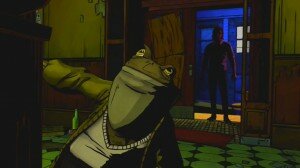
Responding to a call from Mr.Toad , formerly of Toad Hall, Bigby arrives at a run-down apartment complex to find a three foot tall toad having a smoke in the hallway.
Thus begins Bigby’s quest to keep order, and your first major decision. Do you let Toad off? Or go by the book? Are you sympathetic? Or not give a damn?
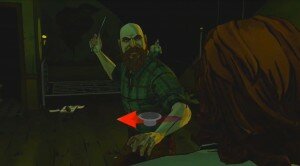
It’s clear from the off that The Wolf Among Us is a very different beast to The Walking Dead. Whilst both game’s central protagonists would rather leave their pasts behind them, unlike Lee, Bigby has no choice but to own his past misdeeds. The other characters are aware of his past, and his reputation precedes him. This is exemplified in Faith’s opening in which Bigby has an altercation with a drunk Woodsman (of Red Riding hood fame) who clearly bears a grudge and refuses to accept Bigby’s authority. Bigby’s past even follows him as he returns to his apartment to find that Colin: one of the three little pigs, has escaped from the Farm and taken refuge in his apartment, insisting that Bigby doesn’t turn him in because he owes him for destroying his home.
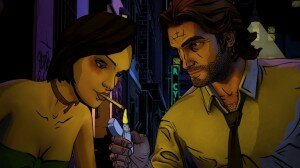 As such, Bigby is caught between his past and his new life in Manhattan. He’s been hired by the ruling class of Fabletown because his reputation for violence and his past actions in the Homelands instils fear into everyone he encounters. However, it’s clear from the outset that Bigby is sick of being the big bad wolf and is constantly battling against the preconceptions of everyone around him. Wanting nothing more than for people to see past his reputation, for example, in a particularly touching scene after Bigby saves the titular Faith from the Woodsman she remarks – “You’re not as bad as people say you are”. Aside from Faith the only other person who sees past Bigby’s gruff exterior is Snow, who Bigby clearly cares dearly for, even if he doesn’t know how to show it as demonstrated during a incredibly awkward but sweet exchange during a taxi ride.
Then again, maybe this is just my Bigby. The choose your own adventure elements of The Wolf Among Us seems to be much more refined than the Walking Dead. Your decisions have a more profound and immediate effect upon your interpersonal relationships and other micro elements of the game. The consequences of your choices also come into play a lot sooner. For example, one act of kindness during the game’s opening will leave you short later on. How you talk to a character early on will affect how cooperative they are later on and so on.
Overall, Faith is an incredibly promising start to a series that could turn out to be Telltale’s best yet, and further proof (if any were needed) of their mastery of the Adventure genre, regardless of the source material.
Episode 2: Smoke & Mirrors 4/5
After the kick in the nuts cliff-hanger that concluded Faith, Bigby is left reeling, finding himself hauled in for questioning by the NYPD. Luckily, this doesn’t last long as Crane rescues our hero using a charm to knock out an entire police department and wipe their memories of the past 24 hours, including all knowledge of the Fable murders that Bigby is currently investigating.
Returning to the sewers beneath town hall , Crane and Bigby, along with a rather blood thirsty Black Beard interrogate whoever you chose to detain at the end of episode 1, what tactics you chose to employ are entirely up to you.
After the interrogation is finished, the chapter begins proper and with it, the dawning realisation that nothing is quite what it seems in the Fables Universe.
The episode’s title – ’Smoke & Mirrors’ is particularly apt, as over the course of the two-ish hours that make up the second episode, Bigby is tasked with unravelling the deepening conspiracy surrounding the murders as well as uncovering a few more in the process.
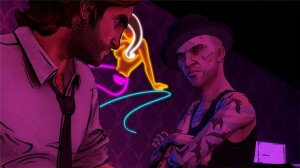 The episode’s stand out scene though, is when Bigby ventures to the Pudding and Pie club run by Georgie Porgie: a slimy pimp, who I’m sure delights in making the girls cry. The back and forth between the two feels like something out of The Sweeny, complete with Bigby potentially smashing up the place to the protestations of the slimy little hoodlum for testing your patience, I have to admit that my usually calm Wolf did trash his club, simply because I didn’t like the bastard!
Although Smoke & Mirrors has a more straightforward and less action packed narrative than Faith, It does do a great job of elevating Bigby’s character to that of a detective rather than the mere enforcer that he appeared to be in Faith. This is highlighted in several scenes in which you decipher clues, solve puzzles and use evidence found within the environment to profile the killer and create new leads. I found these particularly enjoyable and a nice counterpoint to the previous episodes focus on action.
Though Smoke & Mirrors doesn’t have the same impact that Faith did, it is still a strong episode in its own right that gives players a deeper understanding of both Bigby’s own inner turmoil as well as that present within Fabletown itself. Unravelling some of the previous episodes mysteries as well as adding even more intrigue to the proceedings, leaving players counting the days until the next exciting episode arrives.
